BA GUA
CHOY LI FUT
DRUNKEN
EAGLE CLAW
HSING I
HUNG GAR
MONKEY
PRAYING MANTIS
SHAOLIN
TAI CHI
WHITE CRANE
WING CHUN
 

"Learning kung-fu is so much easier wtih your ebooks! I love it!" Carol G. (Portland, USA)


"I enjoyed your first Drunken eBook, and bought the remaining set as well!" Gerrard T. (Sussex, UK)


"My friend recommended your website to me. Your ebooks are good value for money!" Alberto S. (Milan, Italy)


Yang Family Tai Chi: The Tai Chi style for old and young

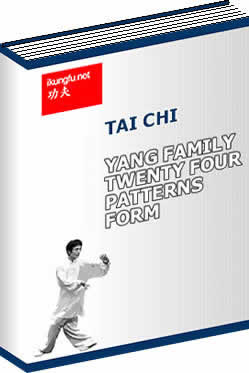
eBook title: Yang Family Tai Chi - 24 Patterns Form, Techniques and Applications

Yang Family Tai Chi - 24 Patterns

Price: US$22.95

Buy Now

Why you should learn Yang Family Tai Chi

Yang Style Tai Chi is an off-shoot of Chen Style Tai Chi, and came into being in the 19 th Century. The founder, Yang Lu Chan was a master of Chen Style Tai Chi. Concerned that some of the aggressive techniques in Chen Style Tai Chi may not be suitable for all people, he refined what he knew into a more relaxed style of Tai Chi that focuses more on large graceful circles with techniques that are easy to understand.

Yang was recruited to teach his style of Tai Chi to the Imperial Guard by the Manchu Dynasty. From there, Yang Style Tai Chi truly flourished as a style in its own right.

Yang Style Tai Chi removes the need for energetic bursts of power prevalent in Chen Style Tai Chi. It focuses on soft flowing movements – The essence being that the technique is driven by the mind or soul, rather than sheer power. Because of this, Yang Style Tai Chi is suited as a health exercise for people of all ages and wellbeing, and has today grown to become the most popular Tai Chi style in the world.


What you'd find in our eBook

In 1956 the National Physical Culture and Sports Commission of the People's Republic of China standardized many Tai Chi forms to make them easier to pick up for beginners. Four masters of the Yang Family Tai Chi style led the development of the form that ultimately became known as the Twenty Four Patterns Form (24 Patterns). 24 Patterns is structured with the beginner in mind and can be performed in around 5 minutes. All the movements come exclusively from Yang Family Tai Chi.

In classic Yang Family Tai Chi forms, key techniques were repeated several times to emphasize their importance. This repetition is done away with 24 Patterns, to make it easier for beginners to learn and remember. More difficult techniques such as the Heel Kick are placed towards the end so that beginners can pick up the form more easily. Yet it retains all the nuances and characteristics of Yang Family Tai Chi.

Because of its straightforward structure, 24 Patterns can be taught quickly to students of all ages and abilities. As the movement is along a straight line it could be done by a large group of people in rows. An example of this is in 1990 when 1,500 students from China and Japan performed the Form jointly at the opening ceremony of the Asian Games. In 1996, 10,000 students practiced the form at Tiananmen Square.

The Form has become widely popular, and many cities and towns across China saw a marked rise in enthusiasm for learning Tai Chi since it was introduced in 1956. Common people embraced it for its accessibility and many health benefits and Deng Xiao Ping (the late leader of the People's Republic of China) praised that "Tai Chi Chuan is good" in a citation to the nation in the nineties. This popularity is certainly well-deserved, as enthusiasm for Tai Chi is not only confined to China - The 24 Patterns is arguably the most popular form of Tai Chi in the world today.

Our eBook contains an illustrated guide to the Yang Family Tai Chi 24 Patterns Form, setting out the form with over 147 diagrams. This is in addition to illustrations and notes setting out the concepts, drills, techniques and their applications associated with the form:

  • Tai Chi Chuan relies on a system of techniques to engage the opponent. Our eBook provides an illustrated description of techniques and stances, including:
    • Fists
    • Palm
    • Hook
    • Elbow
    • Shoulder
    • Front of foot
    • Base of foot
    • Side of foot
    • Knees
    • Horse stance
    • Forward stance
    • 4:6 stance
    • Single legged stance
    • Cat stance
    • Collapsing stance

  • The Ten Principles of Yang Family Tai Chi is the critical interpretative framework for understanding how your body should be positioned in Tai Chi practice. Originally in Chinese, we provide a review of the concepts covered in the Ten Principles in easy to understand English.

  • Coordinated breathing is essential in order to harmonize your external movement with internal strength. Our eBook sets out the principles of proper breathing, including the following concepts:
    • Calmness of mind
    • Closing & opening
    • Inverse breathing
    • Dan Tien


  • The way in which a Tai Chi practitioner interacts with the opponent is based on different types of "Jin". Our eBook discusses the key concepts of "Jin", including:
    • Anticipation of the enemy's force
    • Dissolving the enemy's attack
    • Counter-attack


  • The Tai Chi Chuan Mantra complements the Ten Principles in understanding how to control your mood and condition your spirit when practicing Tai Chi Chuan. Originally in Chinese, we provide a review of the concepts covered in the Mantra in easy to understand English

  • Push Hands is used to develop your sensitivity towards the various types of power ("Jin") in Tai Chi Chuan. Our eBook discusses the principles of Push Hands, including how the principles of "Beng", "Fu", "Ji", "An", "Cai" , "Li", "Zhou", "Kao" can be applied, with diagrams

  • If you have a partner, you can practice Push Hands at home. Our eBook covers key Push Hands exercises with diagrams - including Single Handed, Double Handed and Non-Static exercises

  • Each technique from the 24 Patterns has a specific purpose. Our eBook describes each application in detail, common mistakes to look out for by beginners and illustrated examples of how each technique can be applied:
    • Opening
    • Parting Horse's Mane
    • White Crane Spreads Wings
    • Rolling Step
    • Playing the Lute
    • Repelling the Monkey
    • Catching Sparrow's Tail
    • Single Whip
    • Cloud Hand
    • Patting the Horse's Neck
    • Heel Kick
    • Ear-Shattering Fists
    • One-Legged Stance (Golden Rooster on One Leg)
    • Fair Lady Shuttling
    • Needle at Sea Bottom
    • Flashing the Arm
    • Deflect, Parry & Punch
    • Like Shutting & Closing
    • Character Ten Cross Hand


Benefits of our eBook:

  • Packed with diagrams:- The illustrations for the form itself comprise of over 147 carefully created color diagrams in addition to the many illustrations in the main body of the eBook.

  • Easy to understand instructions:- Our eBooks contain detailed instructions written by our expert editors setting out the form.
  • Multiple camera angles:- Multiple angles of the technique are covered in the diagrams where applicable so that you can see the technique from all perspectives.
  • Printer friendly:- The eBook is in PDF format, and can be printed from any printer.
  • Prompt customer service:- We are an established business, and your inquiry will be answered within the same day. Please simply send your email to sales@ikungfu.net
  • Compatible with all PC computers:- Our eBooks are compatible with all versions of Windows, including Windows 7 and Vista.


Payment and Download Instructions:

  • Click on the "BUY NOW" icon above.

  • After payment is processed, click "Continue" on the Payment Completion page to download your eBook immediately.

  • We accept all major credit cards and Paypal.


100% Risk Free Guarantee

We are very confident that our product will work to your complete satisfaction. However, if you are unable to download or use it on your PC, we will be happy to refund your money.


Copyright 2005 - 2010 (c) ikungfu.net All rights reserved