ikungfu.net    

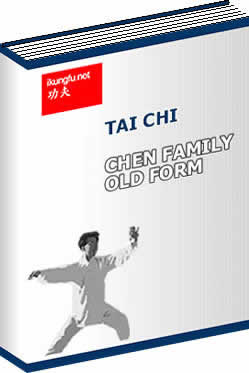
Chen Family Tai Chi - Old Form eBook
Dissolve the opponent's attack with the silk reeling palm

Chen Family Tai Chi - Old Form


Price: US$26.95

Buy Now

About Chen Family Tai Chi

Founded during Ming Dynasty
Chen Family Tai Chi was founded in Hebei Province by Chen Wang Tin about three centuries ago. Chen practiced martial arts since a very young age and became highly skilled and was appointed the commander of the forces of the Ming Dynasty in the province in 1641.

Consolidation of Taoist Principles
After the fall of the Ming Dynasty, he went into hiding and led a simple life farming to live out the rest of his days. During this time, he also consolidated his martial arts knowledge, namely Taoist principles of fighting and breathing, into the Old Form.

Characteristics of the style
Chen Family Tai Chi consists of two forms, called the Old Form and the New Form. Chen Family Tai Chi flows with the attacker's strength until an opening is created, upon which a strike is launched with hard external force.

Few hard blocks
There are no hard blocks in Chen Family Tai Chi. The aim is two-fold in combat:

  • To cultivate and channel a type of passive energy called the Dissolution Force (known as "Hua Qin" in Chinese) to draw in any incoming strike like a vortex and dissolve it completely; and
  • Overwhelm your opponent with a strong burst of Exerted Force (known as "Fa Qin" in Chinese) to counter-attack
Every technique in the Old Form is a deflection or re-direction using the Dissolution Force in combination with a counter-attack technique using the Exerted Force.

Silk Reeling Force
Chen Family Tai Chi focuses on Chi development and cultivation of the Exerted and Dissolution Forces, especially the technique known as Silk Reeling Force ("Lian Shi Qin" in Chinese). It focuses on circling to absorb and dissolve the opponent's energy like a vortex, as well as using internal will to project power. Chen Family Tai Chi is the most aggressive and dynamic of the Tai Chi styles.


Legend of Tai Chi Quan - Zhang San Feng

Founder of the Wudang Sect
Legend has it that Tai Chi originates from Zhang San Feng, the founder of the Taoist Wudang Sect, the only martial arts sect in China that could rival the Buddhist Shaolin Temple. The Wudang Sect emphasizes the cultivation of Chi, the building of internal strength as opposed to the external arts such as Shaolin Long Fist. This focus is directly related to focus of Taoism on deep breathing, meditation and prolonging of life.

Shaolin Temple
Zhang was born towards the end of the Yuan Dynasty. As a boy he worked within the Shaolin Temple as an errand boy of sorts within the temple kitchen. He had an immense interest in kung fu at an early age. Unfortunately as he was never inordinated, he was not allowed to receive training in Shaolin Kung Fu. During his time there, he befriended the kitchen's master furnace stoker who could perform amazing feats with his bare hands using his Chi. He could handle a cauldron of boiling water with his bare hands, and chop wood for the fire with his palms day and night. It turned out that the master stoker was a hidden master of the Shaolin internal arts cultivated over decades unbeknownst to the Temple Abbot.

Secret pupil of the furnace stoker
The master stoker taught Zhang the secrets of Chi cultivation over several years without teaching him any kung fu techniques, much to Zhang's frustration. Always wanting to learn "real kung fu" Zhang could only satisfy his curiosity by spying at the training courtyard where the warrior monks practiced.

Caught by the Warrior Monks
Zhang was caught one day in the Temple courtyard spying on the monks training by a senior monk. Zhang panicked and in his haste knocked out the senior monk across the court yard with a simple punch. Little did he know that with his internal training, he had already developed immense power even though he never received training on formal kung fu techniques - Power that surpassed even that of the warrior monks

Escape from the Shaolin Temple
With all the commotion caused by the warrior monks thinking they had caught a spy, the Temple Abbot came forth to question how Zhang came to have such ability. Surrounded by the crowd, Zhang prepared for the worst. Suddenly, the master stoker rushed by and pushed aside the crowd to intervene carrying a huge kitchen bucket. He threw Zhang into it. Without stopping, the master stoker knocked aside the gathering crowd and Zhang escaped the Temple before the Temple Abbot could intervene, and never looked back.

Wudang Mountains
Preferring to live out his days in a secluded lifestyle, the master stoker told Zhang his training in the internal arts was complete, and parted ways shortly thereafter at the foot of Song Mountain (where the Shaolin Temple was situated). A few years later, Zhang arrived at the Wudang Mountains. One day, while reflecting on how streams could wear away rocks, it dawned on him that a soft and pliable force can prevail over a seemingly hard and fixed object.

The seeds of Tai Chi Chuan
Zhang reflected on the concept of the soft prevailing over the firm and how it can be applied to martial arts. His efforts culminated in Tai Chi Quan, a form of kung fu that emphasizes using the Chi through all body passages, using the soft to counter the firm, and inertia to counter movement. Zhang then began passing his skills to pupils from Wudang Mountain, where his style became known as the Wudang Sect.

Several different sects
In modern times, Tai Chi has split into the several schools or families, with the major ones being Chen Family, Yang Family and Wu Family Tai Chi.

  • Chen Family contains hard as well as soft techniques, some resembling regular kung fu with fast hard power and footwork.
  • Yang Family emphasizes large graceful circles, and the techniques are easy to see and understand
  • Wu Family focuses on smaller circles with more throwing and pushing techniques.


About Chen Family Tai Chi - Old Form

A classic form of Chen Family Tai Chi
The Old Form is one of the classic forms of Chen Family Tai Chi, designed to develop proper breathing, pushing hand techniques, understating of the Exerted Force and Dissolution Force, Silk Reeling, circular motion and persistent energy flow for combat.

What our eBook covers
Our eBook contains an illustrated guide to the Chen Family Tai Chi Old Form, setting out the form with over 248 diagrams. This is in addition to illustrations and notes setting out the concepts, drills, techniques and their applications associated with the form:

  • Tai Chi Chuan relies on a system of techniques to engage the opponent. Our eBook provides an illustrated description of techniques and stances, including:
    • Fists
    • Palm
    • Hook
    • Elbow
    • Shoulder
    • Front of foot
    • Base of foot
    • Side of foot
    • Knees
    • Horse stance
    • Forward stance
    • 4:6 stance
    • Single legged stance
    • Cat stance
    • Collapsing stance
  • The static and dynamic theories of Chen Family Tai Chi provides an interpretive framework for understanding how its techniques can be applied. Our eBook covers these with illustrations, including:
    • Proper posture theory
    • Three Points Theory
    • Harmonization of the internal and external
  • Coordinated breathing is essential in order to harmonize your external movement with internal strength. Our eBook sets out the principles of proper breathing, including the following concepts:
    • Calmness of mind
    • Closing & opening
    • Inverse breathing
    • Dan Tien
  • Understanding the stages of power and how they are applied is important in order to appreciate how Chen Family Tai Chi works. Our eBook covers these and the different ways of using "circling" power against your opponent:
    • Exertion Force (Fa Qin)
    • Silk Reeling (Lian Shi Qin)
    • Dissolution Force (Hua Qin)
  • Push Hands is used to develop your sensitivity towards the various types of power ("Jin") in Tai Chi Chuan. Our eBook covers the principles of Push Hands and provides Illustrated diagrams of Push Hands exercises, including:
    • Explanation of the 8 forces - Beng, Fu, Ji, An, Cai, Li, Zhou, Kao
    • Single push hands - Push hands with one arm
    • Double push hands - Push hands with two arms
    • Static four points - "An, Beng, Fu, Ji" training
    • Da Fu - Push Hands with circling
  • Each technique from the Old Form has a specific purpose. Our eBook describes key applications with illustrated examples of how each technique can be applied:
    • Opening
    • Single whip
    • White crane opens its wings
    • Like shutting and closing
    • Shuttling maiden
    • Ear-shattering fists
    • Returning the tiger to its mountain
    • Stallion grooming its mane
    • Stallion star afar
    • Seven Stars Step
 

Benefits of our eBook

  • Informative and packed with diagrams
    You will find set out in our eBook the complete traditional form, packed with carefully created diagrams to show you the entire form in addition to the many illustrations in the main body of the eBook on background concepts, techniques, drills and applications relevant to the form.

  • Easy to understand instructions
    Our eBooks contain detailed instructions written by our expert editors in a friendly, easy to read style. All text is in English.

  • Multiple camera angles
    Multiple angles of the technique are covered in the diagrams where applicable so that you can see the technique from all perspectives.
  • Printer friendly
    The eBook is in PDF format, and has been formatted with the proper margins and can be printed from any printer.
  • Customer service
    If there are any queries, our contact details are:
    - Phone: (852) 9403-1610 (Hong Kong)
    - email: customerservice@ikungfu.net
  • Compatible with all PC computers
    Our eBooks are compatible with all versions of Windows, including Vista.
  • Mac OS X
    Mac users can access the file within Bootcamp or Virtual PC, using Windows XP.
 

Payment and Download Instructions

  • Click on the "Buy Now" button above.
  • After payment is processed, click "Continue" on the Payment Completion page to download your eBook immediately.
  • We accept all major credit cards and Paypal.
 

Money Back Guarantee

satisfactionWe are very confident that our product will work to your satisfaction. However, if you are unable to download or use it on your PC, we will be happy to refund your money.


2005-2009 ikungfu.net All rights reserved.